

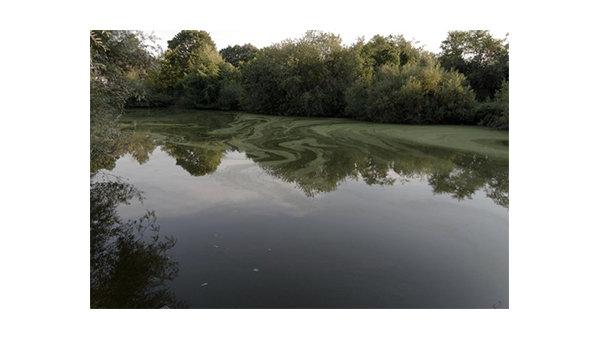
What is the dominant and most abundant life-form on Earth? Surprisingly, it is not humans, cows, trees, grass, or insects. By a very wide margin, bacteria dominate our planet.

The biomass of bacteria exceeds all of Earth’s plants and animals combined. The bacterial population is estimated to be about 5 million-trillion-trillion. Bacteria, by themselves, fulfill the prophet’s words in Isaiah 45:18, that God created Earth to be inhabited. These tiny life-forms cover every inch of Earth’s continents, oceans, soils, and even some of the deep parts of Earth’s crust.

Many species of bacteria are able to live under extremely harsh conditions; for example, in acidic hot springs, freezing saltwater, or even in radioactive wastes.

Most bacteria thrive in an oxygen-rich environment, but some can grow only where oxygen is not present at all. One of the most common of these anaerobic bacteria is Moorella thermoaceticum, ubiquitously found at the bottom of stagnant ponds. It normally consumes sugar and excretes acetic acid. However, when sugar is not present, M. thermoaceticum will metabolize carbon dioxide and methane into acetic acid.

Could Bacteria Help Solve Global Warming?

A team of seven chemical engineers at the Massachusetts Institute of Technology (MIT) noted that the metabolic pathway (carbon dioxide + methane → acetic acid) could remove from the environment two of the most potent greenhouse gases that are released by industrial activity.1 (Of the total list of human activities that have been determined to contribute to global warming, the release of carbon dioxide and methane into the atmosphere adds up to about half.) However, acetic acid is not a very convenient or economic byproduct. The MIT team wondered if the acetic acid produced by M. thermoaceticum could be converted into a more economically valuable product.

After much research and lab experimentation, the team found a way to reengineer the yeast species of bacteria, Yarrowia lipolytica, so that it can metabolize acetic acid into an oil product that can then be easily transformed into diesel fuel. The MIT team is confident that with further enhancements to boost efficiency, what they discovered could be scaled up so that vats of M. thermoaceticum and Y. lipolytica could be built into coal- and gas-fired electrical power plants and into steel mills and other energy-intensive factories to convert the greenhouse gases released by such plants and factories into saleable diesel fuel.

If the initiative proposed by the researchers were to be adopted by the nations of the world, the climate stability that we humans have enjoyed for the past 9,000 years2 and that has made our global high-technology civilization possible may be sustained for a longer time period than would otherwise be the case. Furthermore, it could be sustained through an economic benefit rather than an economic penalty.

M. thermoaceticum and Y. lipolytica, nearly invisible creatures with scientific names, provide yet another example of how God, in advance, has provided all the resources we need to address ecological problems in a manner that is both optimally ethical and economic. It just takes creativity, ingenuity, perseverance, and especially faith in God’s providence on our part to both discover and properly implement God’s creation. For more examples of such provisions by God, see my book, Hidden Treasures in the Book of Job. Aren’t you glad God created such a diversity of bacteria and yeast? I encourage you to find some time today to thank God for creating M. thermoaceticum and Y. lipolytica.

Food for Thought

Do you think God has provided all the resources we need to deal with global warming? Visit TNRTB on Wordpress to comment with your response.

Subjects: Life Design

Check out more from Reasons to Belive @ Reasons.org

About The Author

Dr. Hugh Ross

Reasons to Believe emerged from my passion to research, develop, and proclaim the most powerful new reasons to believe in Christ as Creator, Lord, and Savior and to use those new reasons to reach people for Christ. I also am eager to equip Christians to engage, rather than withdraw from or attack, educated non-Christians. One of the approaches I’ve developed, with the help of my RTB colleagues, is a biblical creation model that is testable, falsifiable, and predictive. I enjoy constructively integrating all 66 books of the Bible with all the science disciplines as a way to discover and apply deeper truths. 1 Peter 3:15–16 sets my ministry goal, "Always be prepared to give an answer to everyone who asks you to give the reason for the hope that you have. But do this with gentleness and respect, keeping a clear conscience." Hugh Ross launched his career at age seven when he went to the library to find out why stars are hot. Physics and astronomy captured his curiosity and never let go. At age seventeen he became the youngest person ever to serve as director of observations for Vancouver's Royal Astronomical Society. With the help of a provincial scholarship and a National Research Council (NRC) of Canada fellowship, he completed his undergraduate degree in physics (University of British Columbia) and graduate degrees in astronomy (University of Toronto). The NRC also sent him to the United States for postdoctoral studies. At Caltech he researched quasi-stellar objects, or "quasars," some of the most distant and ancient objects in the universe. Not all of Hugh's discoveries involved astrophysics. Prompted by curiosity, he studied the world’s religions and "holy books" and found only one book that proved scientifically and historically accurate: the Bible. Hugh started at religious "ground zero" and through scientific and historical reality-testing became convinced that the Bible is truly the Word of God! When he went on to describe for others his journey to faith in Jesus Christ, he was surprised to discover how many people believed or disbelieved without checking the evidence. Hugh's unshakable confidence that God's revelations in Scripture and nature do not, will not, and cannot contradict became his unique message. Wholeheartedly encouraged by family and friends, communicating that message as broadly and clearly as possible became his mission. Thus, in 1986, he founded science-faith think tank Reasons to Believe (RTB). He and his colleagues at RTB keep tabs on the frontiers of research to share with scientists and nonscientists alike the thrilling news of what's being discovered and how it connects with biblical theology. In this realm, he has written many books, including: The Fingerprint of God, The Creator and the Cosmos, Beyond the Cosmos, A Matter of Days, Creation as Science, Why the Universe Is the Way It Is, and More Than a Theory. Between writing books and articles, recording podcasts, and taking interviews, Hugh travels the world challenging students and faculty, churches and professional groups, to consider what they believe and why. He presents a persuasive case for Christianity without applying pressure. Because he treats people's questions and comments with respect, he is in great demand as a speaker and as a talk-radio and television guest. Having grown up amid the splendor of Canada's mountains, wildlife, and waterways, Hugh loves the outdoors. Hiking, trail running, and photography are among his favorite recreational pursuits - in addition to stargazing. Hugh lives in Southern California with his wife, Kathy, and two sons.


Email Sign-up

Sign up for the TWR360 Newsletter

Access updates, news, Biblical teaching and inspirational messages from powerful Christian voices.

Thank you for signing up to receive updates from TWR360.

Required information missing

This site is protected by reCAPTCHA, and the Google Privacy Policy & Terms of Use apply.