



Christian Thinkers 101: A Crash Course on Blaise Pascal

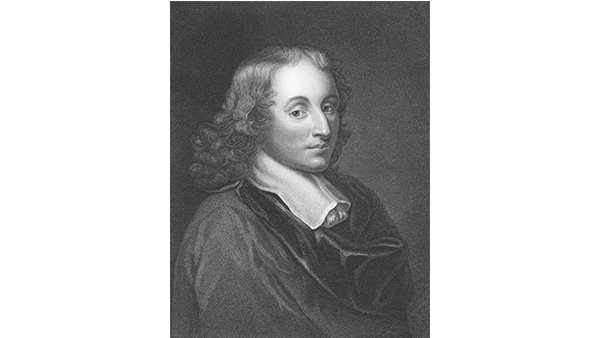

Did you know that the first digital calculator was invented by a seventeenth-century French mathematician? In his brief time on Earth, Blaise Pascal (1623–1662) wore many hats and left an imprint on both modern science and Christian philosophy that lingers to this day. Here’s your crash course on the life and accomplishments of Blaise Pascal—and why he still matters today.
Who Was Blaise Pascal?
Blaise Pascal lived during the scientific revolution and worked as a mathematician, physicist, inventor, polemicist, and writer. His invention of the calculator was one of the major achievements of the early scientific revolution and the precursor to the modern computer.
Pascal grew up as a nominal Catholic, but as an adult he had a dramatic religious experience that led him to commit his life to Christ and to put his remarkable mind to work for Christ’s kingdom. As a Christian philosopher, theologian, and apologist, Pascal provided a penetrating and provocative analysis of Christianity’s broader world-and-life view. In particular, Pascal’s wager argument was a key contribution to Christian apologetics. He accomplished all this before dying at the age of 39.
What Did Pascal Write?
Two of Pascal’s books are still read with appreciation today: The Provincial Letters and Pensées (pronounced “Pon-SAYZ” and roughly translated as “Reflections”). In The Provincial Letters, a book celebrated for its stylistic prose, Pascal supports the controversial Catholic Jansenist movement against the Jesuits. Pensées was published posthumously as an unfinished apologetic work consisting mainly of organized and unorganized notes, outlines, and fragments. Pascal had been preparing a book on Christian apologetics for his skeptical friends when he died of a serious illness. While Pensées is really more of an outline than a complete book, its content is so profound that it remains a perennial bestseller.
What Did Pascal Believe?
Pascal’s three most important ideas or arguments for the God of Christian theism are the following:
- According to Pascal, humans are a strange mixture of “greatness and wretchedness.” Christianity accounts for this human enigma, postulating that the greatness is the result of being made in God’s image while the wretchedness extends from humankind’s fall into sin. In Pensées, Pascal concludes, “Knowing Jesus Christ strikes the balance because he shows us both God and our own wretchedness.”1
- In Pascal’s understanding of how faith and reason relate, the heart and the mind both play an important role in a person coming to faith. The heart provides intuition in the process of forming our most basic beliefs, whereas the mind provides the complementary discursive reasoning. Pascal states: “We know the truth not only through our reason but also through our heart.”2
- Pascal believed the evidence in favor of Christianity is strong. He formulated his wager argument to help motivate people to respond in faith to that evidence. Pascal’s wager says: If a person does not believe in God and God does not exist, then that person gains nothing. On the other hand, if a person does not believe in God and God actually does exist, that person stands to lose everything. The consequence for wagering incorrectly would involve an infinite loss (eternal exclusion from life with God, or hell). In terms of a cost-benefit analysis, the one who wagers against God has nothing to gain and everything to lose. Given these two options, Pascal logically asserts that the prudent person should wager on God.

Why Does Pascal Matter Today?
Some have criticized Pascal as a fideist (negatively defined as someone believing that faith has no rational foundation). However, this assessment is simplistic. Secularists have asserted that his religious experience caused him to lose interest in science, even though Pascal’s scientific achievements mark him as one of the most advanced thinkers of his time. He was the quintessential renaissance man. His contributions to science, mathematics, and popular invention were both profound and enduring; at the same time his approach to Christian theology and apologetics set him apart as a unique Christian thinker.
When evangelicals speak of the difference between head and heart, or how humans are both gifted and flawed, or talk about the limits of science in explaining the world, they are affirming ideas that Pascal articulated and passionately defended. Pascal is important today because he uniquely understood the power and the limitation of science.
Other articles in the Christian Thinkers 101 series: St. Augustine; C. S. Lewis
Reflections: Your Turn
Reflect upon Pascal’s description of human nature being great and wretched. How well does this describe you? Visit Reflections on Wordpress to comment with your response.
Check out more from Reasons to Believe @ Reasons.org