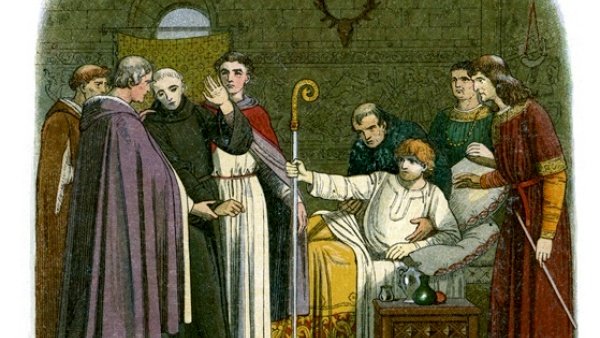
Can faith and reason be compatible? Does reason support the truth claims of Christianity? Many people today believe in a false dichotomy that forces faith and reason into separate categories—but thinkers like St. Anselm, a medieval Italian, have offered compelling arguments for integrating faith and reason. St. Anselm’s ontological argument for God’s existence was a significant, though controversial, contribution that still impacts Christian apologetics. Here’s your crash course on the life and accomplishments of St. Anselm—and why he matters today.

Who Was St. Anselm?

After joining the Benedictine order as a monk, St. Anselm (1033–1109) became a high-ranking ecclesiastical figure serving in church leadership in France and England. Ultimately he became archbishop of Canterbury. Throughout his adult life, St. Anselm sought to reform the church and monastic life. He was a major Catholic theologian and philosopher and made important contributions to Christian doctrine, philosophical theology, and apologetics. Though an Augustinian in his basic approach to theology and philosophy, St. Anselm contributed his own unique and powerful insights to Christian thought. He was also known for his rich devotional life; some of his prayers and meditations have been preserved in his writings.

What Did St. Anselm Write?

Among several works, St. Anselm’s two most important apologetics-related books are Cur Deus Homo (Latin: “Why the God-Man?”) and Proslogion (Latin: “Discourse”). In Cur Deus Homo, he explains and defends why Jesus Christ the Savior must be both God and man (a single person who has both a divine and a human nature) in order to reconcile a holy God with sinful humanity. In Proslogion, St. Anselm tackles the relationship between faith and reason and the arguments for the existence of God.

What Did St. Anselm Believe?

Perhaps St. Anselm’s three most important ideas or arguments for the God of Christian theism are the following:

  1. Once a person becomes a believer via divine grace, the Christian then uses his or her mind to uncover the necessary reasons behind the historic Christian faith. Thus, Anselm’s approach to reflection begins in faith but then achieves understanding through reason. Ultimately faith and reason are understood to be compatible.
  2. The biblical God is the greatest conceivable being (a being “than which none greater can be conceived”) and thus God’s existence may be known through the rational reflection of God’s perfect nature. St. Anselm’s ontological argument is understood as a pure a priori rational argument for God’s existence and is considered the most controversial and contested of all the so-called traditional proofs for God.
  3. St. Anselm’s Satisfaction Theory of Atonement says that humanity’s fall into sin injured God’s honor. Therefore, humankind must render satisfaction to a righteous God, but only God can truly make amends—and He did, through Christ’s sacrifice.


Why Does St. Anselm Matter Today?

Philosophers have been divided over the viability of St. Anselm’s ontological argument.1 However, contemporary Christian philosopher Alvin Plantinga has defended a form of St. Anselm’s ontological argument, reinforcing that it shows belief in God is rational.2 So philosophers, both Christian and non-Christian, are reflecting upon St. Anselm’s ideas almost 1,000 years after his death.

St. Anselm of Canterbury is revered as a doctor of the Catholic Church and has been called the greatest Christian thinker between St. Augustine and St. Thomas Aquinas. He is also known as the father of scholasticism for his major contributions to medieval theology and philosophy. He is known for his ability to successfully combine the challenging roles of church leader and scholar.

St. Anselm has also influenced evangelical protestants. For when evangelicals suggest that faith and reason are compatible or that unbelief is unreasonable, they are affirming some of St. Anselm’s ideas.

Other articles in the Christian Thinkers 101 series: St. Augustine; C. S. Lewis; Blaise Pascal

Reflections: Your Turn

St. Anselm suggested that the person who has faith should seek understanding. How do you view faith’s relationship to reason? Visit Reflections on Wordpress to comment with your response.

Check out more from Reasons to Believe @ Reasonso.org

About The Author

Kenneth R. Samples

I believe deeply that "all truth is God’s truth." That historic affirmation means that when we discover and grasp truth in the world and in life we move closer to its divine Author. This approach relies on the Christian idea of God’s two revelatory books - the metaphorical book of nature and the literal book of Scripture. As an RTB scholar I have a great passion to help people understand and see the truth and relevance of Christianity's truth-claims. My writings and lectures at RTB focus on showing how the great doctrinal truths of the faith (the Trinity, the Incarnation, the Atonement, creation ex nihilo, salvation by grace, etc.) are uniquely compatible with reason. This approach reflects the historic Christian apologetics statement - "faith seeking understanding." I work to help myself and others fulfill Peter's words in 2 Peter 3:18: "But grow in the grace and knowledge of our Lord and Savior Jesus Christ. To him be glory both now and forever! Amen." As an RTB scholar I have a great passion to help people understand and see the truth and relevance of Christianity's truth-claims. • Biography • Resources • Upcoming Events • Promotional Items Kenneth Richard Samples began voraciously studying Christian philosophy and theology when his thirst for purpose found relief in the Bible. He earned his undergraduate degree in philosophy and social science from Concordia University and his MA in theological studies from Talbot School of Theology. For seven years, Kenneth worked as Senior Research Consultant and Correspondence Editor at the Christian Research Institute (CRI) and regularly cohosted the popular call-in radio program, The Bible Answer Man, with Dr. Walter Martin. As a youth, Kenneth wrestled with "unsettling feelings of meaninglessness and boredom," driving him to seek answers to life's big questions. An encounter with Christian philosophy in Mere Christianity by C. S. Lewis led Kenneth to examine the New Testament and "finally believe that Jesus Christ is the divine Son of God, the Lord and Savior of the world." From then on, he pursued an intellectually satisfying faith. Today, as senior research scholar at Reasons to Believe (RTB), Kenneth uses what he's learned to help others find the answers to life's questions. He encourages believers to develop a logically defensible faith and challenges skeptics to engage Christianity at a philosophical level. He is the author of Without a Doubt and A World of Difference, and has contributed to numerous other books, including: Lights in the Sky and Little Green Men, The Cult of the Virgin, and Prophets of the Apocalypse. He has written articles for Christianity Today and The Christian Research Journal, and regularly participates in RTB's podcasts, including Straight Thinking, a podcast dedicated to encouraging Christians to utilize sound reasoning in their apologetics. He also writes for the ministry's daily blog, Today’s New Reason to Believe. An avid speaker and debater, Kenneth has appeared on numerous radio programs such as Voice America Radio, Newsmakers, The Frank Pastore Show, Stand to Reason, White Horse Inn, Talk New York, and Issues Etc., as well as participated in debates and dialogues on topics relating to Christian doctrine and apologetics. He currently lectures for the Master of Arts program in Christian Apologetics at Biola University. Kenneth also teaches adult classes at Christ Reformed Church in Southern California. Over the years Kenneth has held memberships in the American Philosophical Association, the Evangelical Philosophical Society, the Evangelical Theological Society, and the Evangelical Press Association. The son of a decorated World War II veteran, Kenneth is an enthusiastic student of American history, particularly the Civil War and WWII. His favorite Christian thinkers include Athanasius, Augustine, Pascal, and C. S. Lewis. He greatly enjoys the music of the Beatles and is a die-hard Los Angeles Lakers fan. Kenneth lives in Southern California with his wife, Joan, and their three children.


Email Sign-up

Sign up for the TWR360 Newsletter

Access updates, news, Biblical teaching and inspirational messages from powerful Christian voices.

Thank you for signing up to receive updates from TWR360.

Required information missing

This site is protected by reCAPTCHA, and the Google Privacy Policy & Terms of Use apply.