



Ionic Strength and Planetary Habitability


In the movie The Martian, actor Matt Damon plays the role of an astronaut stranded on Mars. He survives by growing potatoes in a greenhouse in Martian soil that he fertilizes with his own bodily wastes.
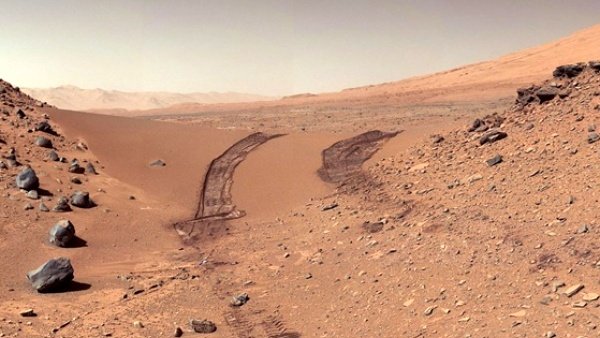
For a number of reasons this movie plot line is not realistic. Martian soil (see featured image) is nothing like Earth soil. For example, it contains about 60 times as much sulfur per unit mass as does Earth soil.1 As I explain in chapter 11 of my new book, Improbable Planet,2 Earth’s soil is a miraculous gift from God that we should never take for granted. It took a few billion years of conditioning by exquisitely designed cryptogamic colonies of microbial life to make Earth’s soil capable of supporting advanced plants like the potatoes the Martian was attempting to grow.
Another factor making Earth able to sustain advanced plants is that Earth’s crust and soil is blessed with elements and compounds of low ionic strength. Ionic strength refers to the number of electrons added to or subtracted from electrically neutral atoms or molecules. Virtually all the elements and compounds that comprise Earth’s crust and oceans are either electrically neutral (same number of electrons as there are protons) or possess just one extra electron per atom or molecule, or are missing just one electron per atom or molecule.
This low ionic strength is one of many requirements for microbial life to possibly exist on a planet. It is also a fundamental requirement for more advanced life and, of course, advanced life cannot exist without microbial life.
In a recent issue of the journal Astrobiology, a team of four earth scientists and astronomers explained that what is normative for Earth may not be normative for other planets.3 In particular, they pointed to measurements from several Martian rover spacecraft showing that Martian soils and brines exhibit high ionic strength.
Because of Mars’ low atmospheric pressure, liquid water can only exist on its surface if it is in a concentrated brine. These Martian brines, as many studies affirm,4 possess high levels of doubly ionized magnesium, iron, and sulfate and triply ionized iron. The presence of these highly ionized metals and compounds strongly disrupts the structure and function of biological molecules. Specifically, proteins and nucleic acids are destabilized and lipid bilayers are disrupted. Such destabilization and disruption is all the more exacerbated by the low pH, low temperature, low water activity, and high levels of dissolved iron in Martian brines.
The team of four earth scientists and astronomers carried out the first assessment of microbial habitability in laboratory-synthesized Martian brines. They found that the brine’s ionic strength was the most important limitation on microbial habitability. Only the most ionically dilute of their simulated Martian brine solutions permitted a few microbial species to survive without catastrophic biological damage.
The team concluded that high ionic strength in a planet’s water acts as a barrier to habitability. Thus, there will be a large percentage of planets residing in the water habitable zones of their host stars that are not habitable at all. The team also noted that high ionic strength will limit the habitability of subterranean oceans on planets and moons. For example, the hypothesized subsurface ocean in Jupiter’s moon, Europa, likely contains high concentrations of doubly ionized magnesium and sulfate,5 which would render it uninhabitable.
In the final paragraph of their research paper the team concludes, “High ionic strength may render an environment uninhabitable even if temperature and water activity are permissive.”6 They add that their data challenges the “paradigm of ‘Follow the Water'”7 that has been the marching orders for astrobiologists for the past two decades.
The team’s research adds one more factor to the several hundred8 factors that already exist that must be fine-tuned to an extraordinary degree for a planet to be truly habitable. Nothing less than the supernatural, super-intelligent handiwork of the Creator God of the Bible can explain why life thrives on Earth and has thrived for so long and with such immense diversity that human beings can now also thrive.9
Endnotes
- Hugh Ross, “Sulfur-Poor Earth Conducive to Life,” Today’s New Reason to Believe (blog), Reasons to Believe, May 4, 2009, http://www.reasons.org/articles/sulfur-poor-earth-conducive-to-life.
- Hugh Ross, “Invisible Progress,” chap. 11 in Improbable Planet: How Earth Became Humanity’s Home (Grand Rapids: Baker, 2016), 134–42.
- Mark Fox-Powell et al., “Ionic Strength Is a Barrier to the Habitability of Mars,” Astrobiology 16 (June 2016): 427–42, doi:10.1089/ast.2015.1432.
- Nicholas Tosca et al., “Physicochemical Properties of Concentrated Martian Surface Waters,” Journal of Geophysical Research 116 (May 2011): id. E05004, doi:10.1029/2010JE003700; Michael Carr and James Head III, “Geologic History of Mars,” Earth and Planetary Science Letters 294 (June 2010): 185–203, doi:10.1016/j.epsl.2009.06.042; Andrew Knoll et al., “An Astrobiological Perspective on Meridiani Planum,” Earth and Planetary Science Letters 240 (November 2005): 179–89, doi:10.1016/j.epsl.2005.09.045; Mark Bullock, Jeffrey Moore, and Michael Mellon, “Laboratory Simulations of Mars Aqueous Geochemistry,” Icarus 170 (August 2004): 404–23, doi:10.1016/j.icarus.2004.03.016.
- Thomas Orlando, Thomas McCord, and Gregory Grieves, “The Chemical Nature of Europa Surface Material and the Relation to a Subsurface Ocean,” Icarus 177 (October 2005): 528–33, doi:10.1016/j.icarus.2005.05.009.
- Fox-Powell et al., “Ionic Strength,” 440.
- Ibid.
- Hugh Ross, “RTB Design Compendium (2009),” Reasons to Believe, November 17, 2010, http://www.reasons.org/articles/rtb-design-compendium-2009.
- I explain and document how every component and event in Earth’s history must be exquisitely fine-tuned to make possible the existence of human beings in my new book, Improbable Planet.
Subjects: Fine-Tuning
Check out more from Reasons to Believe @Reasons.org