



If the Flood was a myth, why didn’t the rest of the Bible writers get the memo?

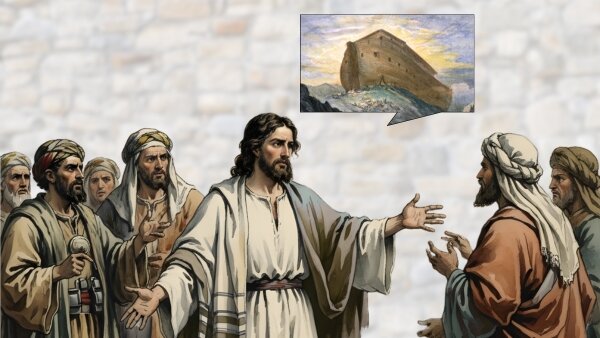

From Psalms to the Apostles, the bible refuses to treat Noah’s flood as a fairy tale.
Dismissing Noah’s Flood as just a metaphor is about as convincing as a leaky umbrella in a hurricane. Still, some insist the Biblical Deluge is ancient myth-making. But before you dive into these murky theories, let’s stroll through Scripture itself, where we find a tsunami of evidence that the Great Flood was a real, historical event.
Grab your rain boots; the Bible isn’t shy about getting its feet wet!
We begin with the poetic giants of Israel. These are not your run-of-the-mill lyricists. Like all Bible writers, they were Holy Spirit-inspired, according to 2 Peter 1:20-21: “knowing this first, that no prophecy of Scripture is of any private interpretation, for prophecy never came by the will of man, but holy men of God spoke as they were moved by the Holy Spirit.”
Psalm 29:10 says, “The LORD sits enthroned over the flood; the LORD is enthroned as King forever.” This is not a bedtime story, this is not a tiny boat on a friendly lake with a smiling giraffe stuffed on board – this is the Flood! The Psalmist uses the most catastrophic deluge in memory to give testimony to God’s power. And Psalm 77:16-20 recounts God’s mighty acts in nature, conjuring images of trembling waters and thunder. These waters “were afraid,” pointing to God’s total control of them. Vivid? Yes. Imaginary? No, simply powerful language like the rest of the psalm, which considers God’s redemptive acts, including the way He led His people “like a flock, by the hand of Moses and Aaron” (verse 20).
Next, let’s take a look at what the prophets said. Isaiah 54:9 relays God’s covenant: “To me this is like the days of Noah, when I swore that the waters of Noah would never again cover the earth.” Isaiah uses Noah’s flood as historical precedent for a new promise – because it actually happened! Ezekiel joins in (14:14, 20), referring to Noah, Daniel, and Job as real figures whose righteousness could save only themselves.
Noah’s inclusion isn’t for poetic effect; it’s because everyone knew he was historical – just as Daniel stands firmly in history. The Babylonian and Persian records confirm the reigns of Nebuchadnezzar, Belshazzar, Darius the Mede, and Cyrus of Persia, perfectly aligning with Daniel’s timeline. And early historians like Josephus wrote of Daniel’s influence in those royal courts – making it clear that he was no mythical figure, but a real man serving in powerful empires.
And it is doubly interesting that the historical Job alludes to the Deluge in Job 22:15-16: “Will you keep to old paths evil men have trod? They were carried off before their time, their foundations washed away by a flood.” He gives no disclaimer about their wickedness being “flooded” away as imaginary. He believed in the historical judgment of the Flood and used it as a warning.
Genealogies may not be thrilling, but they’re Biblical history’s backbone. In 1 Chronicles 1:4, Noah isn’t lost in myth – he is listed as a direct ancestor. If the chronicler was inventing people, he certainly loved detail. The same is true for New Testament writings, as Luke documents Noah being in Christ’s lineage.
If Jesus also mentioned Noah or the flood or both, that could be really enlightening! Well…
Jesus Christ, the very Son of God, uses the flood to describe His second coming. Matthew 24:37-39: “As it was in the days of Noah, so it will be at the coming of the Son of Man…” People were “eating, drinking, marrying” up to the day Noah entered the ark. Jesus isn’t telling a story – He’s using a real event as a wakeup call for future judgment. Luke 17:26-27 repeats the point. If you think Jesus was speaking symbolically, you’ll need a good reason for His matter-of-fact tone.
The apostles weren’t shy about Noah. Hebrews 11:7 celebrates Noah’s faith: “when warned about things not yet seen, in holy fear built an ark to save his family”– not allegory, but history. In 1 Peter 3:20, Peter mentions “those who were disobedient… when God waited patiently in Noah’s days while the Ark was built.” No fairy tale here. In 2 Peter 2:5, Noah is called “a preacher of righteousness,” while God “brought the Flood on the ungodly.” Peter doubles down in 2 Peter 3:5-6, referencing the earth’s destruction as proof of God’s promises. The apostles went to great lengths to confirm the Great Flood’s reality.
Beyond specific references, the Flood is loaded with meaning. Judgment, faith, and covenant – the pillars of Christian thought – are anchored in the reality of the Great Cataclysm. God’s judgment was neither theoretical nor theatrical; it was world-altering. Noah’s faith is celebrated because he trusted God in the face of real danger. The covenant God made after the Flood (Genesis 9) is cited repeatedly as the model for His promises. The flood’s reality anchors hope, warning, and assurance.
So, what do we make of all this? Every biblical genre – psalms, prophecy, genealogies, Jesus’ own words, apostolic doctrine – treats Noah’s Flood as literal history. Not a poetic embellishment, not a sleepy time fable, but a real act of God shaping history and theology. The Bible’s treatment of the Flood is so consistent, you’d need a boat just to escape the waves of evidence. Let’s stand firm, with awe and conviction, on Scripture’s authority. When the waters rise – of skepticism or challenge – the Great Flood remains a bedrock: real, unyielding, and forever a testament to God’s power and faithfulness.
- David MacMillan, Creation Moments Board Member
Check out more from Creation Moments @creationmoments.com/