



How Steam Engines Determined the Laws of the Universe (Part 2)

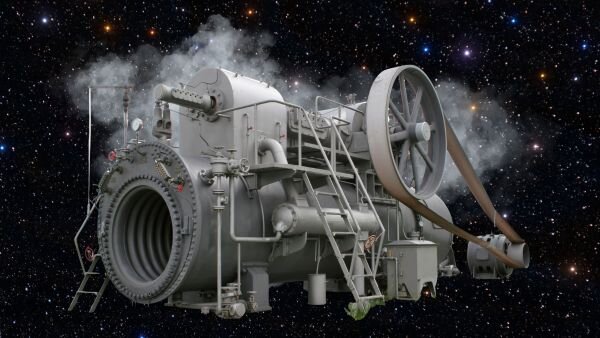

In Part 1 (last week), we noted how an understanding of the great technological advancement of the early 1800’s, the steam engine, drove some key understanding of the governing laws of the universe. Our great “Law Giver”, the God of the Bible, not only established key principles for our protection and moral application, e.g., the Ten Commandments, but He created numerous other principles for the operation of His Creation. We described how two fundamental laws of science came out of this analysis of steam engines: the First and Second Laws of Thermodynamics. And we noted how these fundamental principles of science are overwhelmingly corroborated by the Bible.
In fact, the Bible is the biggest reason the Scientific Revolution and the Scientific Method itself came out of Western Europe (occurring between AD 1550 and AD 1700) right on the heels and in sync with the Protestant Reformation (AD 1517) and the invention of the moveable type printing press (AD 1440). Martin Luther’s 95 Theses on the door of the Wittenberg Cathedral marked a major shift in theological reform, putting the life-giving words of the Bible into the languages and hands of lay people. And his 95 Theses, sparking the Reformation, were printed and quickly spread all over Europe. The Bible right away came to be the best-selling, most printed book of all time. And the fact that our biblical Creator is a personal principle-giving God gave European mankind the faith to uncover and discover those principles of science! As Francis Bacon, formulator of the Scientific Method in 1620 (hypothesis, testing, observations, thesis), said, “We have two books to learn from. God’s word, the Bible. And God’s works, the Creation.”
Rudolf Clausius summarized the First and Second Laws of Thermodynamics by saying: “The energy of the universe is constant; the entropy of the universe tends to a maximum”.
He coined the term “entropy” from the Greek word for “transformation”, as a measure of the energy in a system “unavailable” for work. So we can say “energy unavailability” tends to its maximum. And this expresses a fundamental “tax” or “curse”, if you will, on our efforts to beat the incessant progress of decay. The overall energy of the universe is fixed – as is implied at the end of the Creation Week in Genesis 2:2 when “God ended His work which He had made”.
Apart from miracles, energy can only change forms, and it must do so in the direction of increasing unavailability. The studies and analyses of steam engines showed that there can be no “perfect machine” that can transform energy perfectly and continuously into work. As Professor P.W. Atkins of Oxford University puts it in his book, “The Second Law”, “…the deep structure of change is decay. At root, there is only corruption, and the un-stem-able tide of chaos” (1984).
In general, the principle can be stated this way. “If a system with many parts has a number of possible conditions in which it can exist, then the possible conditions in which the entropy (or dissipation) is approximately a maximum have a probability that exceeds all others combined by an enormous factor ” (Goldman, 1968).
Editors make a living cleaning up and clarifying written communications. Computers have to be defragged and debugged with hard-drive scans on a regular basis to prevent the dissipation of ordered information. Houses and machinery fall apart unless maintained. Increasing entropy is proven over and over, in millions of ways, billions of times every day.
Everything naturally scatters in the direction of maximum disorder and wears down or wears out. The direction of natural change is decay, not increased order, as evolutionists try to argue. To overcome entropy always requires the input of outside intelligence and energy. Jigsaw puzzle pieces are not scattered with increased order, but with increased disorder. A deck of cards when shuffled never becomes ordered, only disordered. A shaker used to season food with equal parts salt and pepper will always disperse the salt and pepper to a maximum state of disorder and appear gray, not separate layers of black and white, no matter how many times it is shaken.
But we can cleverly arrange the puzzle pieces and the deck of cards using our intelligence and the energy in our fingers. And we can use tweezers with concentration and intelligence to pick apart the salt and pepper and form separate layers again. With the input of intelligence, we can circumvent the natural direction of entropy and develop order and complexity. In the midst of disorder, we can intelligently use energy from the sun, for example, as solar power, or wind power, or from fossil fuels, to accomplish a multitude of things.
Yet in spite of all our ingenuity and technology, the overriding principle remains. The whole universe is subject to increasing entropy through the dissipation of energy, the chaotic scattering of elementary particles, and the degradation of information transfer. All our intelligent projects and technology wear down and wear out. They decay with time. So do the things of nature. Apart from the programmed intelligence within the genetic heritage of living things, which lead to production, regeneration, and growth, matter wears out and decays.
Whatever mankind accomplishes with energy and intelligence is always offset by greater decay in ways foreseen and unforeseen. Pollution and loss of biological diversity accompany technical and commercial development. Our bodies wear out in spite of medical technology. This is essentially a “curse” on the efforts of mankind. Death and decay plague progress; they plague life as we know it, bringing with them misery, pain, and suffering. With such consistent and overwhelming decay through the scientific principle of increasing entropy, evolution actually has no way to progress.
Evolutionists try to rebut the problem of increasing entropy by saying that the law applies to a “closed” system, not an “open” system. With constant input of energy from the sun, the earth is an “open” system, for example, so somehow, they say, evolution can get around increasing entropy. But this is a logic fallacy of misapplication, or a smokescreen using technical definitions. The earth relative to the sun is not the same as an electric motor relative to a power supply. The sun may cause seeds to sprout and plant growth through photosynthesis. But these things are the results of pre-programmed genetic “intelligence” in plant DNA, not just effects caused by the sun’s energy making the earth an “open system”. And, of course, plants still wither and die in time. While energy stored in the sun is degraded as it becomes heat and light for the earth.
The law of increasing entropy applies to random mutations just as it does to the random shuffling of cards or the random extraction and placement of jigsaw puzzle pieces. The movement toward disorder overwhelms the rare hypothetical beneficial mutation. This also defies and overrules evolution. Mutations are never known to add more genetic information leading to new “kinds” of species. Instead, unless the organism escapes with a relatively neutral effect, mutations are observed to destroy genetic information and debilitate a species in accordance with the scientific law of increasing entropy – as in years of X-Ray mutation studies on fruit flies through much of the 20th Century.
Evolutionists often raise the example of bacteria becoming resistant to antibiotics as an example of organisms mutating beneficially for their survival. But this is a fallacy. To destroy a bacterium, antibiotics attach themselves to a ribosome in the bacterial cell. If a mutation leads to a misshapen ribosome, the antibiotic may not be able to “grab hold of” the bacterium, and the bacterium becomes resistant. Yet this is a loss of genetic specification, not a gain, and it renders the bacteria weaker under normal conditions. It would be as if someone born without hands is considered an evolutionary advance, because they cannot shake hands with a disease-infected person, thus avoiding contracting a certain disease. Clearly, the loss of hands is a loss of overall viability and not a genetic advance.
Beneficial mutations may be very rare but not impossible, the evolutionists argue. But the problem for the evolutionist is that a rare, occasional beneficial mutation would be so overwhelmed by the harmful and neutral ones that it could not be “naturally selected” for species replication and advancement. It is a little like trying to hit the right tennis ball correctly while being bombarded with thousands of tennis balls on your side of the court. The beneficial mutation is so overwhelmed that it does not influence the natural selection process (Sanford, 2005). This is why irradiated fruit fly experiments never worked.
The Bible, unlike religious books promoting endless seasonal cycles of reincarnation, proves its grasp on truth because it has said long before entropy was even a word that the whole of creation was “in bondage to decay” (Romans 8:21). And it makes the excellent analogy with garment decay in Isaiah 51:6 “…the earth will grow old like a garment, and those who dwell in it will die in like manner; but My salvation will be forever and My righteousness will not be abolished”.
People grow old and die. The Bible says this is because of sin. “For the wages of sin is death” (Romans 6:23). It says that quote “…a curse devours the earth” (Isaiah 24:6) because its inhabitants have “…broken the everlasting covenant” (Isaiah 24:5). There is a present “abnormality” of nature because of the Fall of man into sin, so that nature is plagued with death, decay, disease, cruelty, and pain; and with maladies like pathogenic microbes, cancers, viruses, and harmful mutations - the frustrations that make this world a tough place. Some people want to blame God for the troubles of this world, but the sin of mankind is responsible for these disorders of creation. A good and just God has had to withdraw His righteous life-support from a corrupted creation. As the Bible puts it in 1 Corinthians 15:50, “…nor does corruption inherit incorruption…”
Only God can supply the energy and intelligence (the miraculous intervention) to bypass the results of increasing entropy. And only God could have supplied the outside energy and intelligence to begin with and given us the miracle of Creation and of human life in the first place! And the Biblical promise is that God will again overcome entropy to give us a “new heaven and a new earth” (Revelation 21:1), no longer subject to the original curse of increasing entropy in its present form. “And God will wipe away every tear from their eyes; there shall be no more death, nor sorrow, nor crying; and there shall be no more pain, for the former things have passed away” (Revelation 21:4). “And there shall be no more curse, but the throne of God and of the Lamb shall be there…” (Revelation 22:3).
Once again, God overcame entropy when He gave us the miracle of the personhood and resurrection of Jesus Christ, by whom we can be saved from the consequence of sin through faith in Him and His marvelous work on the cross on our behalf! And those who trust in Jesus Christ can look forward to a redeemed life free of the curse of decay, with our wonderful Maker and Savior!
- Atkins, P.W., The Second Law, Scientific American Library, Scientific American Books, W.H. Freeman and Co, New York, New York, p 200, 1984.
- Goldman, Information Theory, Dover, N.Y. 1968
- Sanford, J.C., Genetic Entropy and the Mystery of the Genome, Chapter 2, Ivan Press, 2005.
Check out more from Creation Moments @creationmoments.com/