



Mars’s Discoveries Showcase Earth’s Design

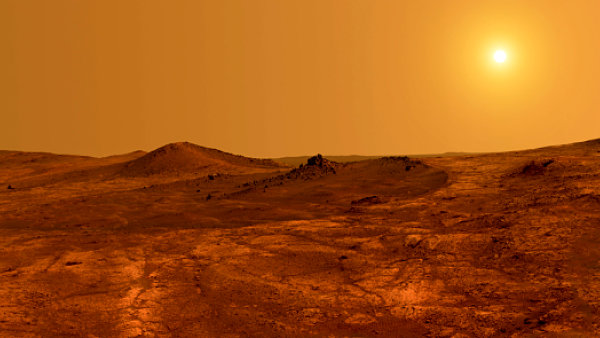

Earth’s neighbor Mars has created a lot of discovery-driven headlines lately. In one, scientists found seasonal variation of methane in the atmosphere. In another, 3-billion-year-old sedimentary rocks contained “tough” organic material. In a third, researchers think the planet’s surface hosts valleys that look a lot like stream networks seen here on Earth. But undoubtedly, the evidence indicating the existence of a large, subsurface lake at Mars’s south pole generated the most buzz. Each of these discoveries was hailed as signs that Mars once supported life—or might still today. While the question of whether life ever lived on Mars remains unanswered, all these discoveries ultimately point to the amazing design behind Earth’s capacity to support life.
It’s worth noting that some level of uncertainty surrounds all these discoveries and their connection to life. For the first, the most likely sources of the methane are abiotic; that is, they don’t involve life.1 In the second discovery, scientists do not know whether organisms formed the organic compounds or if they formed “naturally” more than 3 billion years ago.2 Three different processes, only one of which involves a water cycle, could cause the network of valleys.3 And, the subterranean “lake” likely consists of a large volume of liquid water mixed with copious amounts of rock, salt, and perchlorates.4
Nevertheless, the data really seems to indicate the presence of methane, some organics, rainwater-formed valleys, and large underground lakes. Even with all these features, the hospitality of Mars as a life site still pales in comparison to Earth’s!
Water in Lakes, Rivers, and Aquifers
Let’s compare the amount of water between the two planets. It’s hard to tell just how much water resides in the lake on Mars. The lake sits about 1 mile below the surface and spans about 12.5 miles. The depth of water is unknown, although detection requires at least a foot or so of depth. Assuming a depth of 100 ft gives an estimate volume of V = (6.25^2)*3.14*(100/5280) ≈ 2.3 cubic miles (mi3). Mars probably has a large number of “lakes” similar to the one described above. Even 10,000 of these lakes on Mars would give a total volume of 23,000 mi3. For comparison, Earth has thousands of surface lakes (just in Minnesota alone) with a total volume of freshwater on the surface of 22,000 mi3—nearly equaling the quantity on Mars. However, Earth’s underground aquifers contain almost 100 times that amount of freshwater (2,000,000 mi3). But all of that nearly evaporates compared to the 321,000,000 mi3 of water in the oceans! The discovery of liquid water lakes on Mars is impressive and important. And it helps quantify the incredible habitability of Earth by comparison.
Rivers, Lakes, and the Water Cycle
Mars shows signs of liquid water having flowed across its surface in the past. Assuming that rivers and rain formed these valleys, we see that Mars had some form of a water cycle. But it ceased eons ago—roughly 3.5 billion years to be precise. In contrast, water played an important role for almost all of Earth’s 4.5-billion-year history. Even zircons that formed 4.2 billion years ago show evidence of water’s activity. Not surprisingly, scientists find evidence of abundant life on Earth for most of that time—back to 3.8 billion years ago. Most people would assume that the presence of water means that life will exist, but I would argue that life requires a stable water cycle. In fact, the first 500–700 million years of Earth’s history shows evidence of water, but no stable water cycle. Incidentally, that idea matches the biblical description of the early Earth. The stable water cycle and long-standing oceans on Earth developed around 3.8 billion years ago after the end of the late heavy bombardment. In contrast, any liquid water on Mars disappeared shortly after this event.
I have stated previously that a number of events and processes work together to ensure the habitability of Earth over the past four billion years. The discovery of an underground lake, valley networks, and organic compounds on Mars may show that some processes worked inefficiently on other planets. But they also show just how remarkable Earth is in its capacity to host abundant life for an incredibly long period of time. It’s almost like Earth was designed for that purpose.
Endnotes
- For a brief description of these abiotic processes, see “Possible Methane Sources and Sinks,” https://mars.jpl.nasa.gov/msl/multimedia/images/?ImageID=6891.
- Jennifer L. Eigenbrode et al., “Organic Matter Preserved in 3-Billion-Year-Old Mudstones at Gale Crater, Mars,” Science 360 (June 8, 2018): 1096–1101, doi:10.1126/science.aas9185.
- Hansjoerg J. Seybold, Edwin Kite, and James W. Kirchner, “Branching Geometry of Valley Networks on Mars and Earth and Its Implications for Early Martian Climate,” Science Advances 4 (June 27, 2018): eaar6692, doi:10.1126/sciadv.aar6692.
- R. Orosei et al., “Radar Evidence of Subglacial Liquid Water on Mars,” Science (July 25, 2018): eaar7268, doi:10.1126/science.aar7268.
Check out more from Dr. Jeff Zweerink @Reasons.org