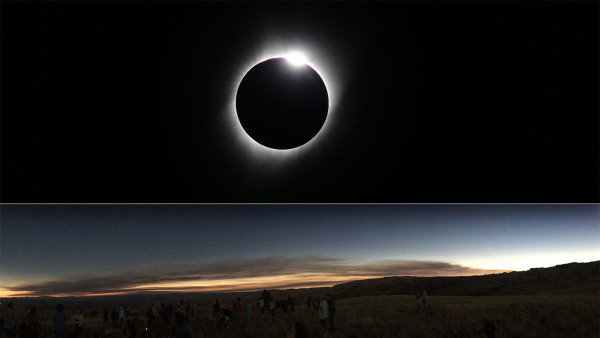
Many people who witnessed the great eclipse of 2017 will remember it as a wondrous spectacle. But one amateur astronomer saw the event as an opportunity to reproduce measurements of the celebrated general theory of relativity, which provides the basis for understanding cosmological models of our expanding universe.

In 1915, Albert Einstein first presented his new model for describing gravity to the Prussian Academy of Sciences. Motivated by the notion that the laws of physics should not depend on location in or motion through the universe, Einstein had developed what we now call the general theory of relativity (GR). When first published, GR did not make much of a splash. Even after three or four years, Einstein lived in relative obscurity until a key measurement in 1919 brought him scientific fame.
blog__inline--mastering-eddingtons-confirmation
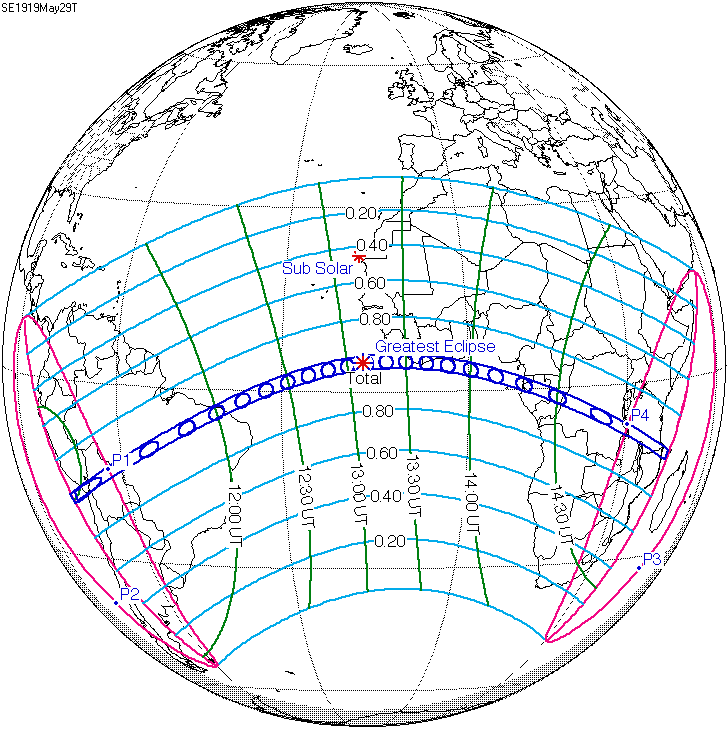
Eclipse Predictions: Fred Espenak, NASA’s GSFC

A solar eclipse that traversed the Atlantic Ocean from South America to Africa propelled Einstein’s theory to prominence. According to GR, the gravitational well of the Sun should deflect light from distant stars by a predictable amount—an amount twice as large as predicted by Newtonian gravity. Like any solar eclipse, weather can unravel the best-laid plans. So astronomer Sir Arthur Eddington planned for two groups to make the critical measurements. Eddington and astronomer Sir Frank Watson Dyson traveled to Sobral, Brazil, while sending fellow astronomers Andrew Claude de la Cherois Crommelin and Charles Davidson to Príncipe Island off the west coast of Africa. Both groups found clear enough skies to observe stars during the eclipse. Eddington used the observations from Príncipe Island to compare star locations during the eclipse and six months earlier (when the same stars are in the sky at night). Eddington published a paper in 1920 declaring that “results of the observations here described appear to point quite definitely to . . . and confirm Einstein’s generalised relativity theory.”1

This first test of GR brought international recognition to Einstein and started a long chain of experiments that establish GR as arguably the most accurate description of the universe known. However, some people have questioned whether Eddington’s result actually supported GR or whether he may have shown some bias.2 History shows that GR is correct and that subsequent reanalysis of Eddington’s data validates his conclusions. Yet, scientists continually seek to improve upon results.

Donald Bruns, an amateur astronomer from San Diego, used a $4,000 telescope and a $5,000 camera to execute a plan he had perfected over two years. He took his setup to Casper, Wyoming, to photograph the 2017 eclipse and measure the deflection of stars as originally done by Eddington. Analyzing the data from his observations, he measured a deflection coefficient of 1.7512 arcsec.3 This value agrees with the predictions of GR within 3%, a marked improvement over previous optical attempts that had only achieved 10% accuracy. According to Physics Today, Brun’s work is “the most accurate and precise ground-based optical version of the Eddington experiment.”

Although Bruns’s research doesn’t fall into the class of “breakthrough,” it does represent scientists’ ongoing pursuit to understand the intimate and minute detailed workings of the cosmos. It also shows that relatively inexpensive projects can contribute significant results. But most importantly, it highlights the incredible curiosity and creativeness that drives humans—bearers of God’s image—to know the truth!

Endnotes
  1. Sir F. W. Dyson, A. S. Eddington, C. Davidson, “IX. A Determination of the Deflection of Light by the Sun’s Gravitational Field, from Observations Made at the Total Eclipse of May 29, 1919,” Philosophical Transactions of the Royal Society A 220 (January 1, 1920): 291–333, doi:10.1098/rsta.1920.0009.
  2. Daniel Kennefick, “Testing Relativity from the 1919 Eclipse—A Question of Bias,” Physics Today 62 (March 1, 2009): 37–42, doi:10.1063/1.3099578.
  3. Donald G. Bruns, “Gravitational Starlight Deflection Measurements During the 21 August 2017 Total Solar Eclipse,” Classical and Quantum Gravity 35 (April 12, 2018): 075009, doi:10.1088/1361-6382/aaaf2a.

Check out more from Dr. Jeff Zweerink @Reasons.org

About The Author

Jeff Zweerink

Since my earliest memories, science and the Christian faith have featured prominently in my life - but I struggled when my scientific studies seemed to collide with my early biblical training. My first contact with RTB came when I heard Hugh Ross speak at Iowa State University. It was the first time I realized it was possible to do professional work incorporating both my love of science and my desire to serve God. I knew RTB's ministry was something I was called to be a part of. While many Christians and non-Christians see the two as in perpetual conflict, I find they integrate well. They operate by the same principles and are committed to discovering foundational truths. My passion at RTB is helping Christians see how powerful a tool science is to declare God's glory and helping scientists understand how the established scientific discoveries demonstrate the legitimacy and rationality of the Christian faith. While many Christians and non-Christians see the two as in perpetual conflict, I find they integrate well. • Biography • Resources • Upcoming Events • Promotional Items Jeff Zweerink thought he would follow in his father's footsteps as a chemistry professor until a high school teacher piqued his interest in physics. Jeff pursued a BS in physics and a PhD in astrophysics at Iowa State University (ISU), where he focused his study on gamma rays - messengers from distant black holes and neutron stars. Upon completing his education, Jeff taught at Loras College in Dubuque, Iowa. Postdoctoral research took him to the West Coast, to the University of California, Riverside, and eventually to a research faculty position at UCLA. He has conducted research using STACEE and VERITAS gamma-ray telescopes, and currently works on GAPS, a balloon experiment seeking to detect dark matter. A Christian from childhood, Jeff desired to understand how the worlds of science and Scripture integrate. He struggled when his scientific studies seemed to collide with his early biblical training. While an undergrad at ISU, Jeff heard Hugh Ross speak and learned of Reasons to Believe (RTB) and its ministry of reconciliation - tearing down the presumed barriers between science and faith and introducing people to their personal Creator. Jeff knew this was something he was called to be a part of. Today, as a research scholar at RTB, Jeff speaks at churches, youth groups, universities, and professional groups around the country, encouraging people to consider the truth of Scripture and how it connects with the evidence of science. His involvement with RTB grows from an enthusiasm for helping others bridge the perceived science-faith gap. He seeks to assist others in avoiding the difficulties he experienced. Jeff is author of Who's Afraid of the Multiverse? and coauthor of more than 30 journal articles, as well as numerous conference proceedings. He still serves part-time on the physics and astronomy research faculty at UCLA. He directs RTB's online learning programs, Reasons Institute and Reasons Academy, and also contributes to the ministry's podcasts and daily blog, Today's New Reason to Believe. When he isn’t participating in science-faith apologetics Jeff enjoys fishing, camping, and working on home improvement projects. An enthusiastic sports fan, he coaches his children's teams and challenges his RTB colleagues in fantasy football. He roots for the Kansas City Chiefs and for NASCAR's Ryan Newman and Jeff Gordon. Jeff and his wife, Lisa, live in Southern California with their five children.


Email Sign-up

Sign up for the TWR360 Newsletter

Access updates, news, Biblical teaching and inspirational messages from powerful Christian voices.

Thank you for signing up to receive updates from TWR360.

Required information missing

This site is protected by reCAPTCHA, and the Google Privacy Policy & Terms of Use apply.