



The Perils of Space Travel

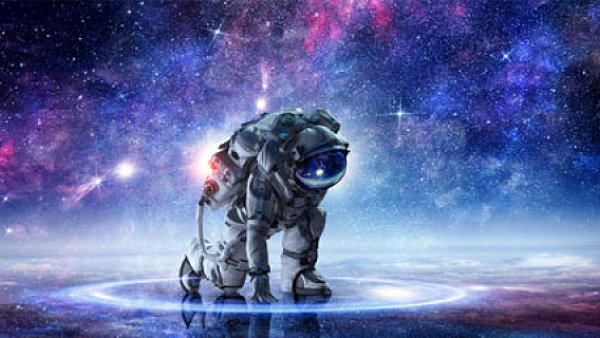

If only space travel were as easy as depicted in Star Wars or Star Trek! Traveling a few thousand times the speed of light onboard the Enterprise or a hundred times faster by jumping to lightspeed enables these fictional ships to traverse stellar distances in fractions of a day. Unfortunately, the real world poses much greater constraints. Even cruising at one-tenth the speed of light (well beyond our current or imaginary technology), the trip to star system Alpha Centauri, our nearest neighbor, would take nearly 45 years. Some of the latest research reveals the damage even a few months in space causes to the human body. By contrast, Earth’s environment seems ideally suited for humans.
Perhaps the most well-known peril of long periods of time in space relates to bone density loss and kidney stones. NASA implements a strenuous exercise regimen, supplemented by medication, to combat these risks. Not surprisingly, muscle degeneration also occurs in the weightless environment of space. According to a recent study of zero gravity on the muscles supporting the back, staying aboard the International Space Station for 6 months resulted in a 5–10% decrease in muscle mass. Back on Earth, the astronauts’ muscle mass returned to normal values within a year or so. However, muscle density also decreased by similar amounts while in space. For some muscles, the effects of this density decrease were measurable 2–4 years later.1
Perhaps exercise and nutrient intake can counteract the effects of long-term space travel, but research also reveals human immune system problems. Another team of scientistsinvestigated the levels of “natural killer cells” (NK cells) for astronauts spending six months or more in space. These NK cells are white blood cells that kill cancerous cells and prevent viral cells within the body from reactivating. The team drew blood samples before launch, during flight, and after return for the astronauts, as well as a control sample of people who remained on Earth. The study showed that the level of NK cells on the long spaceflights decreased by 50%.2 If such an effect grows with flight duration, the consequences would result in most (if not all) space travelers developing cancer or succumbing to previous viral infections that immune systems on Earth naturally keep in check. Such problems become more severe considering that long-duration spaceflights induce a condition called HALS—hydrocephalus associated with long-duration spaceflight. The buildup of fluid in the brain causes increased brain pressure in the part of the brain responsible for body movement and higher executive function.
These problems result from spaceflights near Earth. Longer trips, like going to Mars, bring another, more severe problem. Flights to Mars require more than six months outside the protective confines of Earth’s magnetic field. Consequently, space travelers are exposed to cosmic radiation that the magnetic field deflects from Earth’s inhabitants. Mice provide a good proxy for the human physiology, so a team of researchers exposed mice to radiation doses similar to those encountered on a trip to Mars. The study showed that cosmic radiation dosage severely damaged the intestinal lining of the mice. Specifically, the gastrointestinal (GI) tract has a 3- to 5-day self-renewing mechanism that keeps the top layers of the tract healthy. The cosmic rays disrupted this renewing mechanism, which dramatically affects nutrient absorption and leads to cancerous growth.3 Additionally, signs of the damage remain at least one year after the radiation exposure ends.
Taken together, these studies demonstrate two points. First, space travel may capture the human imagination, but the physiological toll of traveling anywhere beyond the Moon may destroy any hope to journey beyond our home planet. Second, the environment of space exposes humanity to seriously detrimental effects. However, our well-designed Earth provides an incredible environment for humanity (and an abundant array of diverse life) to not only survive but to truly thrive.
Check out more from Reasons to Believe @Reasons.org
Endnotes
- Katelyn Burkhart, Brett Allaire, and Mary Bouxsein, “Negative Effects of Long-Duration Spaceflight on Paraspinal Muscle Morphology,” Spine, published ahead of print (December 8, 2018), doi:10.1097/BRS.0000000000002959.
- Austin B. Bigley et al., “NK-Cell Function Is Impaired during Long-duration Spaceflight,” Journal of Applied Physiology (November 1, 2018), doi:10.1152/japplphysiol.00761.2018.
- Santosh Kumar et al., “Space Radiation Triggers Persistent Stress Response, Increases Senescent Signaling, and Decreases Cell Migration in Mouse Intestine,” Proceedings of the National Academy of Sciences 115, no. 42 (October 16, 2018): E9832-41, doi:10.1073/pnas.1807522115.