



First Image of a Black Hole

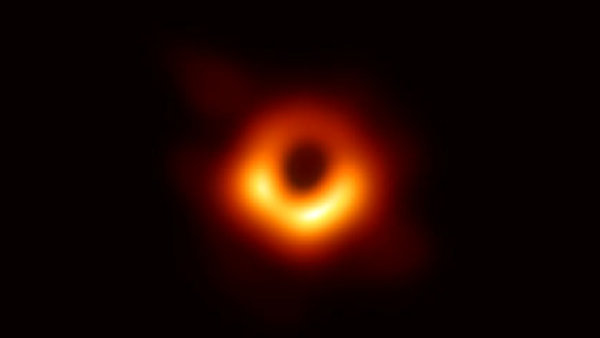

When Albert Einstein first proposed his general theory of relativity, it transformed the way scientists thought about space and time. Specifically, the theory predicted that mass could be so compressed that it would rupture the fabric of space-time. Scientists called these things black holes. Over the last hundred years, numerous experimental and theoretical findings have affirmed the existence of black holes, but to date scientists had not imaged one. That changed with a first-ever radio image of galaxy M87, which revealed the shadow of an enormous black hole at its center. This first astronomical image of the black hole shadow highlights a number of cool things about black holes and carries worldview implications.
The Nature of Black Holes
What is a black hole? Some claim it is the tunnel at the end of the light, or maybe what you get in black socks. More seriously, consider the task of launching something into space from Earth. Conceptually, all that such a launch needs is for the object to exceed the escape velocity (around 25,000 mph at Earth’s surface). Anything traveling faster than that, regardless of its mass, will escape Earth’s gravity and fly into space. Now, imagine collapsing all of Earth’s mass into a tiny ball the size of a proton. As you get closer and closer to the tiny ball, the gravitational pull increases and so does the escape velocity. Move to 1 mile from the ball and the escape velocity increases to 700,000 mph. This seems large, but the escape velocity from the surface of the Sun is almost 1,400,000 mph! However, if you now move within a quarter of an inch of the ball, the escape velocity exceeds the speed of light and you would forever be confined within the gravitational pull of the tiny Earth. A region of space with so much gravitational attraction that it requires going faster than the speed of light to escape is a black hole. Scientists use the term event horizon to describe any distance from the black hole where the escape velocity exceeds the speed of light.
Black Holes Can Be Really Massive
Astronomers used the 8 ground-based telescopes of the Event Horizon Telescope (EHT) and trained its gaze (in radio wavelengths) toward a galaxy called M87. An event horizon grows as the mass of the black hole increases. Where the event horizon for an Earth-mass black hole is about 9 millimeters, a Sun-mass black hole’s event horizon is 3 kilometers. Scientists have used various techniques to measure the mass of the black hole at the center of M87—with results in the range of 3 to 8 billion times the mass of the Sun! Using the latest image of the black hole from the EHT, scientists determined that the black hole had a mass of 6.5 billion times the mass of the Sun.1 Given this mass, the event horizon would extend roughly 120 times the Earth-Sun distance. If this black hole replaced the Sun at the center of the solar system, then the event horizon would reach four times farther than the orbit of Neptune. Some truly massive black holes exist in our universe!
Scientists Are Really Ingenious
The great distance to M87 required some innovative research. How do you image an object (that emits no light) the size of the solar system that is almost 60 million light-years away? The team of scientists “imaged” the black hole by coordinating observations from 8 different radio telescopes scattered around the globe! The long distances between the telescopes provided greater resolution than any of the individual telescopes. Each telescope generated around a petabyte of data (1 million gigabytes). From that measure, the scientists could work to correlate the data from the different telescopes into one with the resolving power capable of reading a book on a café table in Paris—from New York!
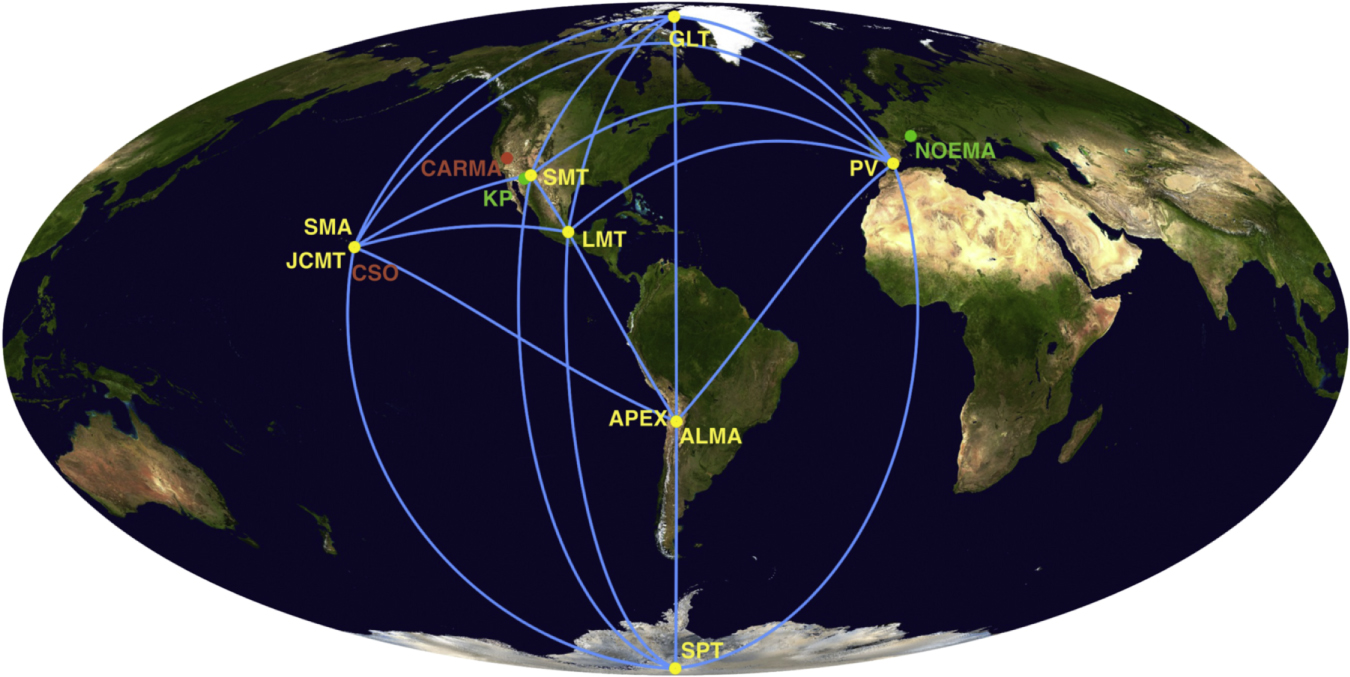
Figure 1: Map of the EHT. Image credit: the Event Horizon Telescope Collaboration2
Affirmation of General Relativity and the Bible
Not that scientists had any great doubt about general relativity’s validity, but these measurements affirm its reliability to accurately describe the dynamics of the universe. Scientists have used black holes in the past for this purpose. By analyzing the interaction of black holes with the cosmic background radiation, astronomers constrained changes in the fine-structure constant. Three years ago, scientists measured the gravitational waves generated by two black holes coalescing into one more massive black hole. This measurement also revealed a class of black holes (ones with a few tens of solar masses) that was previously unknown!
More importantly, the validity of general relativity shows that science often operates by taking philosophical ideas (that the laws of physics should be constant for all observers, regardless of motion) and testing them with the way the world operates. If science can do this with philosophical ideas, then it ought to be able to test various biblical claims about how the universe works—like constant laws of physics (Jeremiah 33:25-26) as well as a beginning to the universe (Genesis 1:1, John 1:1)
Thus far, the Bible has a good track record in describing the universe such as its beginning, the conditions on early Earth, the common ancestry of Arabs and Jews, and perhaps even the crossing of the Red Sea. Given its reliability, wouldn’t that mean people should take seriously what the Bible has to say about how we relate to the Creator of this amazing universe?
Check out more from Reasons to Believe @Reasons.org
Endnotes
- The Event Horizon Telescope Collaboration et al., “First M87 Event Horizon Telescope Results. I. The Shadow of the Supermassive Black Hole,” Astrophysical Journal Letters 875, no. 1 (April 10, 2019): L1, doi:10.3847/2041-8213/ab0ec7.
- The Event Horizon Telescope Collaboration et al., “First M87 Event Horizon Telescope Results. II. Array and Instrumentation,” Astrophysical Journal Letters 875, no. 1 (April 10, 2019): L2, doi:10.3847/2041-8213/ab0c96.