



Is the Universe a Billion Years Younger?

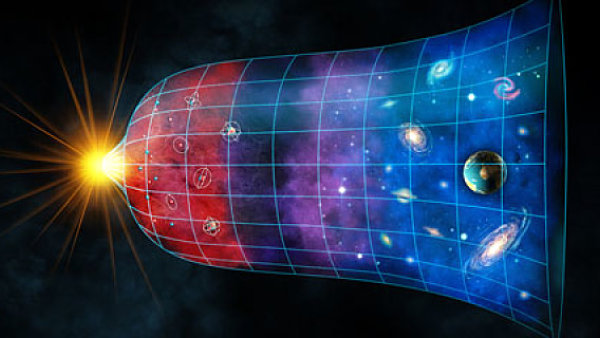

AP News recently ran an article with the headline “New Study Says Universe Expanding Faster and Is Younger.” Numerous other media outlets echoed the story, adding that the universe may be a billion years younger—as young as 12.5 billion years old. Is this just science changing its mind again? How could researchers be so wrong? A little historical insight coupled with some scientific background help show why scientists are excited about this seemingly large discrepancy.
Expansion History Gives Universe’s Age
The most sensitive way to measure the age of the universe relies on knowing the expansion history. This technique works similarly to calculating how long it will take you to drive to your vacation destination. If you know the distance and how fast your car will move, determining the driving time is simple. Typically, you will assume a constant speed, but the calculation works even with changing speeds as long as you know how the speed changes over time. Since Edwin Hubble discovered the expansion of the universe in 1929, astronomers have measured the heavens to determine its rate of expansion (and the corresponding age). Interestingly, when Hubble first measured what we now call the Hubble constant, Ho, his value gave an age of the universe around 1.8 billion years old. However, scientists thought the earth was at least 2 billion years old.
Is the Hubble Constant 50 or 100?
In the 1970s and 1980s, astronomers divided into two different camps regarding the Hubble constant. Given the straightforward process of finding the redshift for a galaxy, virtually all astronomers agreed on how fast various galaxies moved away from us. The main difference in the two camps related to distance measurements of those galaxies. One group, behind the work of Allan Sandage and Gustav Tammann, argued for a Hubble constant around 50 kilometers/second/megaparsec (km/s/Mpc).2 The other group, based on the work of Gérard de Vaucouleurs, claimed the Hubble constant was closer to 100 km/s/Mpc.3 Each group published error bars between 5–10 km/s/Mpc so there was no way to reconcile the results. The smaller values of Ho gave an age of the universe around 20 billion years; the larger values were closer to 10 billion years. Given this background, the current discrepancy of one billion years represents a marked improvement! Even without knowing the final answer, most scientists favored the smaller values of Ho because the ages of globular clusters were calculated around 15 billion years old.
Resolving the Current Discrepancy
NASA launched the Hubble Space Telescope in large part to resolve the discrepancies in the measurements of the universe’s expansion rate. After numerous years of work (and many other developments in cosmology), scientists published a value of H0 = 72 ± 8 km/s/Mpc—more or less splitting the difference.4 Measurement improvements over the last two decades reduced the error bars from 8 to about 1.5. The current discrepancy in H0 arises from a different way of making the measurement. Scientists can also use the ripples in the cosmic microwave background radiation to determine H0, and this technique gives a value around 67 ± 0.7 km/s/Mpc. Again, the size of the error bars makes these two results irreconcilable. However, one should note that using the larger value to calculate an age for the universe gives something around 12.5 billion years (using “standard” cosmological parameters) but the oldest objects in the universe are more than 13 billion years old! This means that rather than making the universe younger, the discrepancy points to new physics that changes the standard cosmological parameters.
Why It Matters
It may seem that a one-billion-year discrepancy undermines the integrity and trustworthiness of the scientific enterprise. Perhaps it justifies skepticism over the validity of big bang cosmology. However, neither of these conclusions is correct. First, the discrepancy shows that our ability to measure the age of the universe and our confidence in the age has increased by a factor of 10 over the past 50 years. Second, in that time, we have also learned about dark matter, dark energy, inflation, and many other things that vastly improve our understanding of the origin and history of the universe. And that understanding continues to provide strong support for big bang cosmology. Third, because of how carefully scientists have tested each of the two discrepant results, scientists think the results give insight into new physics about how the universe ages. And scientists find that prospect exciting.
Check out more from Reasons to Believe @Reasons.org
Endnotes
- Edwin Hubble, “A Relation between Distance and Radial Velocity among Extra-Galactic Nebulae,” Proceedings of the National Academy of Sciences 15, no. 3 (March 15, 1929): 168–73, doi:10.1073/pnas.15.3.168.
- A. Sandage and G. A. Tammann, “Steps toward the Hubble Constant. VII. Distances to NGC 2403, M101, and the Virgo Cluster Using 21 Centimeter Line Widths Compared with Optical Methods: The Global Value of H0,” Astrophysical Journal 210 (November 15, 1976): 7–24, doi:10.1086/154798.
- G. de Vaucouleurs, “Five Crucial Tests of the Cosmic Distance Scale Using the Galaxy as Fundamental Standard,” Nature 299 (September 23, 1982): 303–7, doi:10.1038/299303a0.
- Wendy L. Freedman et al., “Final Results from the Hubble Space Telescope Key Project to Measure the Hubble Constant*,” Astrophysical Journal 553, no. 1 (May 20, 2001): 47–72, doi:10.1086/320638.