



Jupiter: No Ordinary Planet

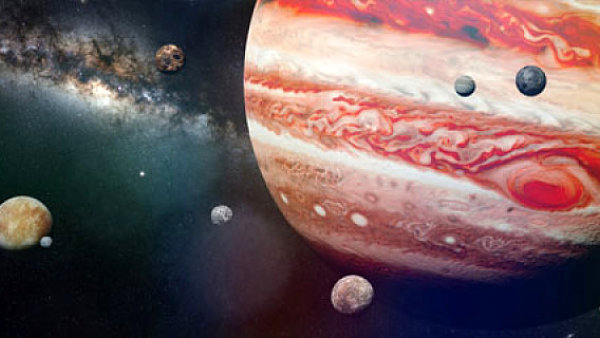

Each planet in our solar system possesses unique and fascinating features. Earth hosts an abundant, dazzling array of life. Mars houses the largest volcanoes and a canyon so vast it would span North America from ocean to ocean. Saturn would float—if you could find a bathtub big enough. But Jupiter stands out, with a 400-year-old storm encompassing a region large enough to contain two Earths, and enough gravitational pull to cause volcanic activity on one of its larger moons. Additionally, Jupiter serves as a shield, minimizing the number of asteroids that hit Earth and cause mass extinctions of life. As scientists find planetary systems around other stars, they naturally want to know whether these systems host similar Jupiter-like planets. After nearly three decades of planet hunting, it looks like Jupiters may be rare.
Many Jupiter-Sized Planets
Although astronomers know of 4000+ exoplanets, they have only determined masses and orbits for roughly a quarter of them (968 as of this publication; filter the catalog with “mass:mjup < 100.0 AND axis:au < 100000.0”). Of those exoplanets with known orbits and masses, 671 have a mass larger than Saturn, or more than 30% of Jupiter’s mass, MJup. Clearly, Jupiter-sized planets make up a majority of the exoplanets found by astronomers. Interestingly, almost 500 of these Jupiter-sized exoplanets orbit closer to their star than the distance from the Sun to Mars. In our solar system, Jupiter orbits at 5.2 AU. (One AU or astronomical unit is the distance from the Earth to the Sun.) Astronomers want to know how commonly Sun-like stars host Jupiter-like planets.
Correcting a Bias
Most of the 4000+ known exoplanets were discovered using either the radial velocity or transit methods. However, these two techniques have the greatest sensitivity to exoplanets close to their host star—much closer than Jupiter’s orbit. Thus, any conclusions drawn from exoplanet data derived solely from these two techniques will give biased information about the frequency of Jupiter-like planets. In contrast, the direct detection method has much more sensitivity to large exoplanets with orbits equal to or larger than Jupiter’s. Using data from all three techniques allows astronomers to gain a more accurate picture.
Suns with Jupiter-Like Planets are Rare
A team of astronomers used the direct detection technique with the Gemini Planet Imager Exoplanet Survey (GPIES). GPIES surveyed more than 300 stars in an attempt to find exoplanets and found nine objects orbiting between 10 and 100 AU. Six were Jupiter-sized planets with masses between 3 and 15 times MJup. The other three were brown dwarf stars with masses more than 25 times MJup.1 These results, combined with the distribution of Jupiter-sized planets from transit and radial velocity surveys, show that Jupiter-sized planet orbits peak in frequency between 1–10 AU (just like Jupiter and Saturn in our solar system).2On its own, this finding seems to indicate that our solar system is ordinary. However, the paper also found a “strong correlation between planet occurrence rate and host star mass, with stars
M* > 1.5MSun more likely to host planets with masses between 2 and 13MJup” for this range of orbits. In other words, Jupiter-like planets (with mass AND orbit similar to the one in our solar system) form less frequently around stars as small as the Sun.
Today, many assume that our solar system represents most planetary systems that form around stars. But as these studies note, the actual data paints a different picture. In the words of Bruce Macintosh, the principle investigator for GPI:
Given what we and other surveys have seen so far, our solar system doesn’t look like other solar systems . . . We don’t have as many planets packed in as close to the sun as they do to their stars and we now have tentative evidence that another way in which we might be rare is having these kind of Jupiter-and-up planets.
It seems that our planets—and Jupiter in particular—make our solar system stand out from the rest. Yet another reason to marvel at our place in the cosmos.
Check out more from Reasons to Believe @Reasons.org
Endnotes
- The difference in distribution and mass of these two classes of objects indicates that they form by different mechanisms. Massive Jupiters likely formed “bottom-up” via the core accretion mechanism (like rocky planets). Brown dwarfs probably formed “top-down” by the gravitational collapse process.
- Eric L. Nielsen et al., “The Gemini Planet Imager Exoplanet Survey: Giant Planet and Brown Dwarf Demographics from 10 to 100 au,” The Astronomical Journal 158, no. 1 (July 2019): 13, doi:10.3847/1538-3881/ab16e9.